Dispensationalism, Dividing the Word, Dividing Walls and all on Flat Earth

A Mystery:

How does a 21st Century Norwegian become a King James Only, Dispensationalist, Not Merely Young Earth but FLAT-EARTH Creationist?

A Living Riddle:

To @aigkenham @CreationMuseum Outer space does not exist, Ken. We live under the firmament on a flat earth which is still. You should know.

When I first saw this Tweet chastising Answers in Genesis’s Ken Ham, I thought it was a jest. The type of jest I might make to emphasize the limits of literalism and to note that every literalist stops being a literalist somewhere. Or do they?flat-earth

I doubt there are many young earth creationists who adopt a biblical biological perspective when it comes to human conception or medicine. If they did, their doctors would prescribe heart medicine for mental disorders and fertility doctors would treat women only and treat the discovery of ova like AIG treats the discovery of background radiation in space and carbon dating.

Out of curiousity, I replied to this tweet and asked, Do you really believe the earth is flat? The individual responded with “Of course I belive the earth is flat that is what the Bible teaches.” I had found someone who was at once more consistent and more of curiousity than Ken Ham.
Continue reading “Dispensationalism, Dividing the Word, Dividing Walls and all on Flat Earth”

Norman Wirzba’s Way of Love (2016): A Book Review

Wirzba, Norman. Way of Love: Recovering the Heart of Christianity New York: HarperOne, 2016. (238 pages + notes & index)


Now available on Amazon.com.

As the subtitle suggests, Duke University Professor Norman Wirzba seeks to remind his readers that love is the heart of Christianity. I do not say at the heart but is the heart because Christian community is rooted in love as revealed in Jesus Christ. And this incarnate love—this incarnate lover— ought to be the driving force behind Christian witness and practice. As the body of Christ, the Church, exists in a world mired in and, indeed, enamoured by sin, followers must regularly be called back to the way of love and Wirzba’s book is one of those calls.

Way of Love is first a letter to the churches. Like the letters of the Apostles that make up the bulk of the New Testament, this letter contains admonishment, encouragement, and a call to keep Christ and therefore love as the heart and goal of what we as followers say and do. In this sense, Wirzba is not telling us something new but telling us the “old, old, story” again in a new and refreshing way. Continue reading “Norman Wirzba’s Way of Love (2016): A Book Review”

How Ken Ham & Answers in Genesis Led Me to Accept Evolutionary Theory

Ken Ham and the folks at Answers in Genesis (AIG) often suggest that what leads people, including biblical scholars, to propose interpretations of the early chapters of Genesis that differ from a “literal” interpretation of Genesis akin to AIG‘s own is a desire to conform their understanding of Scripture (and doctrine) to modern scientific theories, i.e. “deep time”, the Big Bang, and, of course, the theory of evolution. In other words, the suggestion is that beliefs about evolution and the age of the universe not only precede but drive Christians to seek alternate interpretations of the early chapters of Genesis that better accommodate modern scientific theories.

The polemical and apologetic narrative usually sounds something like the following from a 2011 post condemning the work of Wheaton College professor John Walton:

Why are we seeing more and more bizarre and elitist ideas (e.g., William Dembski—see previous blog post for details) coming out of Christian academia? I believe it is a form of academic pride, largely from academic peer pressure, because these people ultimately “loved the praise of men more than the praise of God” (John 12:43).

Continue reading “How Ken Ham & Answers in Genesis Led Me to Accept Evolutionary Theory”

How to Teach Genesis 1 (Part II): Psalms: Creation or Exodus

Duck-Rabbits and Other Ways to Transform Perception

How to Teach Genesis 1 (Part I): Don’t Begin with “In the Beginning . . . “

In these well-known optical illusions, on initial observation the observer sees one or the other of the two possible figures in the image.img_0232-1 At first, one sees either the duck or the rabbit. When the observer who sees a duck is told to look for the rabbit, they must begin to identify rabbit features to reframe their perspective.img_0233 The duck’s bill becomes the rabbit’s ears. Similarly, with the old/young woman, one must focus on a particular feature and reinterpret it or see it as something else.

It is not possible to see both simultaneously. The brain switches back and forth between the two possible interpretations.

In a somewhat analogous way, something similar happens when we look at other creation accounts in the Christian Scriptures. And yes, you read that correctly. There are other portrayals of creation beyond the two that are most familiar to us in Genesis 1-3. (See for example Job, Psalm 77, 78, passages from Isaiah, John 1, Colossians 1, etc.) Moreover, it may be that these other biblical creation accounts pre-date those we find at the beginning of our Bibles. That is, they may have existed as part of the oral culture and worship practice of Israel and may even have been committed to papyrus before Genesis 1-3. (Of course, dating of texts is often difficult.)

As the title of this post suggest, the two events that Israel often described coincidentally and in overlapping images are the establishing of the cosmos and the establishing of Israel. Both events are seen as the creative acts of the God of Abraham, Isaac, and Jacob. These events are so closely associated for the biblical authors that it is frequently (and, perhaps, invariably) the case that they find they cannot speak of one without speaking of the other.

Let’s look at an example from Psalm 89. Continue reading “How to Teach Genesis 1 (Part II): Psalms: Creation or Exodus”

Four-Legged Insects and the Genesis Flood

Source: Four-Legged Insects and the Genesis Flood Follow this link to my Baylor blog Christianity and Creation. From time to time, I will post science related articles on Christianity and Creation.

Inspiration and Incarnation (Part IV and Final): A Review of Peter Enns’s Book 

In the fourth chapter of Peter Enns’s  Inspiration and Incarnation, Enns turns his attention to the question of how the New Testament authors use the Old Testament. It is a question of hermeneutics or interpretation. Thanks to Rikk Watts at Regent College it is also one of my favourite topics in Biblical Studies. So, as with much of this book, I come at with preformed opinions. As I indicated in the previous post, I thought if I were going to find something “disagreeable” in this book it might come in this chapter. Yet, again, I found nothing in this chapter that accounts for the negative and sometimes viscious reaction of some evangelicals against Enns and his view of Scripture. Continue reading “Inspiration and Incarnation (Part IV and Final): A Review of Peter Enns’s Book “

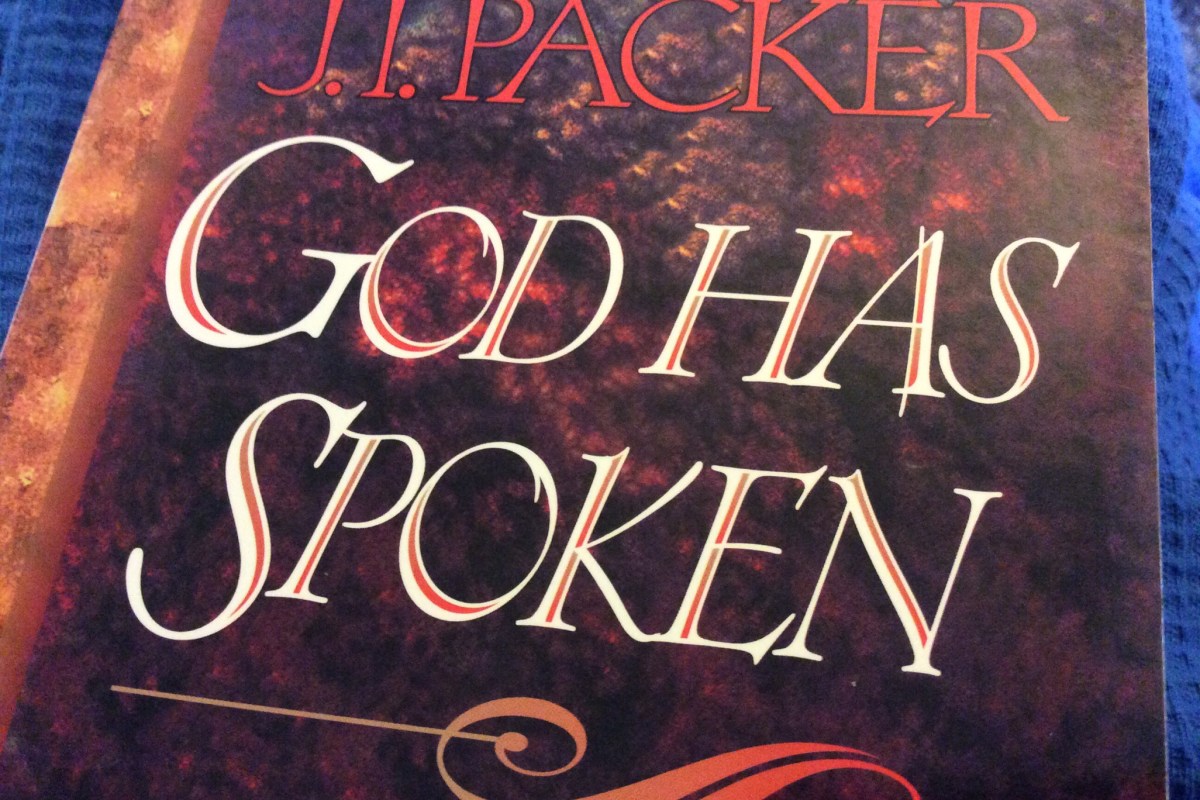
God Has Spoken 2: Reflections on J.I. Packer’s Book

“Some modern theologians say, ‘God doesn’t speak.’ Well, He says, He does.”

J.I. Packer from Lecture at Regent College

God Has Spoken: Revelation and the Bible 3rd Edition

Chapter Two: The Lost Word

Apparently, although I have not scientifically verified it, there is more than one way to skin a cat. Likewise there is more than one way to lose the Word of God.

Losing the Word

In the second chapter of God Has Spoken, Packer draws an analogy between the famine of the Word announced by the prophet Amos to the people of the Northern Kingdom in the eighth century BC and his contemporary situation. That is, while Creator God spoke to the people through the prophets to His people, there came a time when a refusal by the people (especially those with power) to listen to God resulted in God answering with silence. If you won’t listen, then I will stop speaking or I will make you deaf.

Christians have always affirmed the authority of the Bible. The earliest Christians affirmed the authority of the Law, the Prophets, and the Writings which Christ and the apostles read as witnessing to the character, covenant and promises of the God of Israel and to Jesus Christ as the fulfillment of those promises and climax of those covenants. At the same time, particular texts written by the apostles and their close associates were used in much the same way. These are commonly referred to as the Old and New Testaments, respectively. Continue reading “God Has Spoken 2: Reflections on J.I. Packer’s Book”