Advent, Christmas, and the Nativity Part I: No Room on the Donkey or Is Joseph an Ass?

Spoiler Alert: If you have not heard the Christmas Story before, this post may give away some surprise elements like Jesus was born in Bethlehem. Oops.

Spoilers of Another Kind: If you want to hold onto some of the traditional features of the nativity, then you may want to avoid this series of Advent posts. My intent is not to ruin Christmas. These posts are not intended to be my own version of Adam Ruins Everything.

So, Mary Rode a Little Donkey before She had a Little Lamb

Now, already with just the title of this post, you likely have a story in your head but how much of this story is actually in the Bible. If it is not there, then where did these extra-biblical elements come from.image

Our sources for the story of the Jesus’s birth and the events leading up to it are found in the Gospels of Matthew and Luke. Mark and John do not include nativity stories. Now, the story we tell is already a harmonized version of these two narratives. There is no real problem with telling a harmonized version of these stories at Christmas time. At least, there is no problem so long as we do not lose sight of the two distinct narratives that are in our canon. Continue reading “Advent, Christmas, and the Nativity Part I: No Room on the Donkey or Is Joseph an Ass?”

Consider the Ant!? Answers in Genesis suggests Invertebrates May Not Be Alive in the “Biblical Sense” or Whaaaat the Sheol?!?!

I can’t make this stuff up. Okay, I could. But I don’t have to because Answers in Genesis has a whole staff of writers who make this stuff up.

In order to defend AiG’s assertion that death only entered the world when ha’adam ate the fruit from the tree of knowledge of good and evil and following a typical AiG strategy, Avery Foley suggests that ants and other insects are not living things[1],

Aside from the possibility that ants, and other insects, are not even alive in the biblical sense . . .

What does “not even alive in the biblical sense” even mean, is it like “knowing someone in the biblical sense”? “Alas, poor Yorick, I knew him well.”[2] Nudge, nudge, wink, wink.[3] Well, under the veneer of real research, AiG often includes footnotes [of course, footnote 1 is the only footnote but surely this indicates that this “scientifically” or “biblically” grounded article must have data to back up such a bold and paradigm shifting claim], let’s scroll down, shall we? Continue reading “Consider the Ant!? Answers in Genesis suggests Invertebrates May Not Be Alive in the “Biblical Sense” or Whaaaat the Sheol?!?!”

Ham-Handed Hermeneutics VII: On The 7th Post the Blogger Reflected

The History of Two Hermeneutical Errors:

Harmonization and Concordism

The claim of Ken Ham and AiG that most of the Church Fathers taught a version of YEC similar to the teachings of Answers in Genesis motivated me to write this series of posts. Yet, responding to this patently false assertion by the folks at AiG was never the sole motivation. I have long had an interest in theology, science, and the history of ideas. An interest that pre-dates my own conversion to Christianity. While I am doubtful that I could ever write as enduring a spiritual autobiography as those provided by Augustine, G.K. Chesterton, or John Henry Newman, I resonate with the life filled with questions the telos of which was and remains Christianity or Orthodoxy.

Even as Spirit-filled Christians, we never have a full grasp of the truth. Indeed, while Christianity tells us of our dignity and value as human beings, it also reminds us of our finitude, our lack of control, our limitations, even, or, perhaps, especially, with respect to our knowledge of the Creator. Most of us have been warned about “putting God in a box” but at one time or another every Christian likely tries to get the Creator in his or her power rather than submitting to the Creator.

So, as I review what I have seen so far in the few Church Fathers that I have inexhaustively explored, I keep in mind that as brilliant as these men, they too are limited. Indeed, they frequently admit their own limitations and errors. Remember, Augustine’s autobiographical work is entitled Confessions and later he wrote a work entitled Retractions. This historical observation leads me to my first comment about AiG’s use of the historical data. Continue reading “Ham-Handed Hermeneutics VII: On The 7th Post the Blogger Reflected”

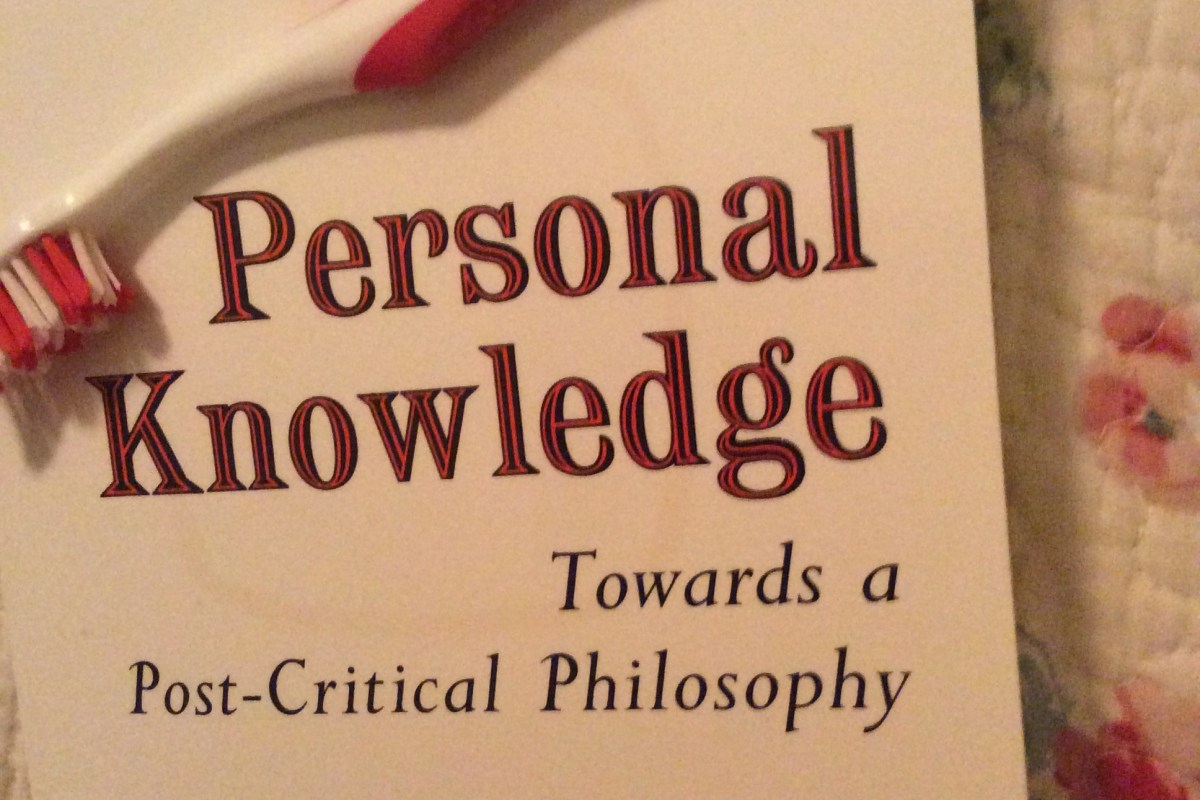
An Objective Look at Personal Knowledge or Trust Me I Read This Book Using the Scientific Method

Michael Polanyi’s Personal Knowledge: Toward a Post-Critical Philosophy: A Teaser Trailer of sorts

The Hungarian born, Michael Polanyi (1891-1976) was a polymath, nominated thrice (yes, I used thrice) for the Nobel Prize, once for his contribution in physics and twice in chemistry. While for much of his academic career, he was a professor of chemistry, he eventually took a chair in social studies.
With his turn to social studies, he began to write and lecture on knowledge (or epistemology), especially as it relates to the scientific disciplines. Wikipedia offers a helpful and concise summary of Polanyi’s concerns and the alternative for which he argues,

In his book Science, Faith and Society (1946), Polanyi set out his opposition to a positivist account of science, noting that it ignores the role personal commitments play in the practice of science. Polanyi was invited to give the prestigious Gifford Lectures in 1951-2 at Aberdeen. A revised version of his lectures were later published as Personal Knowledge (1958). In this book Polanyi claims that all knowledge claims (including those that derive from rules) rely on personal judgements. He denies that a scientific method can yield truth mechanically. All knowing, no matter how formalised, relies upon commitments. Polanyi argued that the assumptions that underlie critical philosophy are not only false, they undermine the commitments that motivate our highest achievements. He advocates a fiduciary post-critical approach, in which we recognise that we believe more than we can prove, and more than we can say. Wikipedia Michael Polanyi 12/01/2015 bold added

In my interdisciplinary, internet and, dare I say, interfaith conversations, I find that those who give the scientific method a special status in their epistemology and claim to know things objectively through the use of this method, rarely demonstrate any evidence that they have critically examined their own commitments to the method and their presuppositions about epistemology. So, I often mention Michael Polanyi who speaks from within the scientific community and yet challenges some of the common presuppositions. Continue reading “An Objective Look at Personal Knowledge or Trust Me I Read This Book Using the Scientific Method”