An Unhappy Marriage III: Don’t Tell Me What I Think (or the Art of Listening)

In this series of posts, I am noting the shared presuppositions of most Young Earthers (YECs) and a particular though common subset of atheists which I am referring to as evangelistic atheists. Evangelistic atheists (EAs) are those who think atheism and atheistic reasoning are “good news” and that as they spread this good news theism (superstition) will decline and the world will become a better place through scientific discovery.

In the west and for obvious reasons, the primary target of evangelistic atheism’s polemical rhetoric is aimed at Christians. In my experience which includes reading, conversation, on-line interaction (i.e. not usually conversational), being a student in anti-Christian contexts, and my own youth which included an element of anti-Christian skeptical agnosticism most evangelistic atheists seem to assume and, indeed, insist that true Christianity is Protestant Fundamentalist Christianity.

Related Posts: Unhappy Marriage II: Stuck in the Middle with YouUnhappy Marriage I: Atheists are from Mars and Young Earthers are from Earth

I am likely stretching my analogy of the Unhappy Marriage to the breaking point but who cares its a blog. Continue reading “An Unhappy Marriage III: Don’t Tell Me What I Think (or the Art of Listening)”

An Unhappy Marriage II: Stuck in the Middle with You

“Clowns to the left of me, Jokers to the right, Here I am stuck in the middle with you.” — Stealers Wheels

We are all fools. One type of fool says in his heart, “There is no God.”

“Answer a fool according to his folly.” Sometimes, you have to set aside your ultimate aims and simply meet people where they are. You can’t just point an atheist to a Bible verse. That’s like quoting your mother to your wife in an argument.

As I suggested in my previous post, we all have biases, prejudices, and presuppositions. In fact, it would be difficult to function in the world without them. Continue reading “An Unhappy Marriage II: Stuck in the Middle with You”

Ken Ham on Homo Naledi: See No Evidence, Hear No Evidence, Speak No Truth

Today’s Reading: Psalm 115 & Jeremiah 7:4

Having read the post on Naturalis Historia about the release of information on H. naledi, I knew it would not be long before Ken Ham and Answers in Genesis (AiG) voiced their collective judgment on the finding. Moreover, I knew what that judgment would be in advance. I am prescient that way. For Ham and AiG, This discovery would change nothing.

So, I was not surprised when Ken Ham released a tweet and a link to an “article” responding to this release of information about H. Naledi. Continue reading “Ken Ham on Homo Naledi: See No Evidence, Hear No Evidence, Speak No Truth”

Mind the Gap I: Diagnosing Split-Brain Syndrome in Young Adults (and the rest of us)

Many Christians seem to suffer from what I am calling “Split-Brain Syndrome”. That is, many Christians seem to switch unwittingly between a Science Brain and a Church Brain. This psychological problem is nurtured by a culture that divides the public and private spheres and is reinforced by a popular polemics that are framed by the conflict models of religion vs. science, faith vs. reason, religion vs. secular, Ham vs. Dawkins, etc. As my own story will demonstrate, this “double-mindedness” is not peculiar to Christians.

Though not a Christian at the time, in my youth, I experienced this split-brain syndrome. Continue reading “Mind the Gap I: Diagnosing Split-Brain Syndrome in Young Adults (and the rest of us)”

Ham-Handed Hermeneutics 2: Reading the Church Fathers II: Theophilus of Antioch (Bishop of Antioch ca. 169-181 AD)

Answers in Genesis (AiG) are consistent in a few things. For instance, they are consistent in their assertions that every geological and archaeological discovery that seems to suggest an old earth can be explained by a global flood. Second, they are consistent in their general inconsistency. (In a future post, I will write about the inconsistency of Ken Ham and AiG with respect to adopting a “biblical scientific worldview”.)

Related Posts & Pages: Ham-Handed Hermeneutics 1: OrigenHeresy of HamHow to Teach Genesis 1Why Seven Days?Cosby’s “Interpreting Biblical Literature”How To Read the Bible for All Its Worth

ken-ham-dinosaur-getty-creation-museumOn the one hand, they decry those who appeal to “the traditions of men” whenever those traditions seem to contradict their raison d’etre. Yet, on the other hand, they are quite prepared to appeal to those same traditions when it suits their purposes. Continue reading “Ham-Handed Hermeneutics 2: Reading the Church Fathers II: Theophilus of Antioch (Bishop of Antioch ca. 169-181 AD)”

How To Teach Genesis One in 30 Minutes

Having spent many words critiquing Ken Ham and AiG’s approach to this discussion, it is about time that I offered an alternative constructive approach to teaching Genesis 1. Continue reading “How To Teach Genesis One in 30 Minutes”

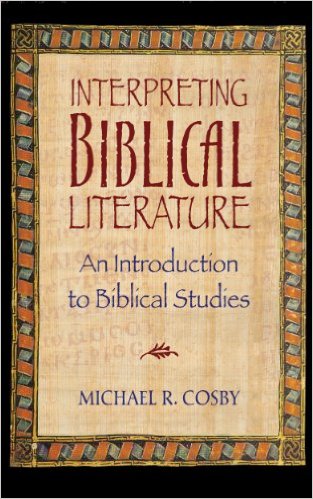
Review: Interpreting Biblical Literature by Michael R. Cosby (Stony Run Publishing, 2009)

Interpreting Biblical Literature: An Introduction to Biblical Studies by Michael R. Cosby (Stony Run Publishing, 2009)

As I prepared to teach a section of Baylor’s Christian Scriptures course, I spent a day or two examining the available introductory textbooks. While it is not a survey course, Baylor’s Christian Scriptures course does cover both Testaments in a single semester. In a survey course, I would feel more compelled to say something about every book of the Bible. Such courses often leave little room for actually modeling and teaching exegetical (or interpretive) practices. Continue reading “Review: Interpreting Biblical Literature by Michael R. Cosby (Stony Run Publishing, 2009)”

Dialogue in Hamean Skepticism (Excerpt from Ham/Hume Post)

Last week, I was asked to share my thoughts on Ken Ham’s Humean Skepticism at a weekly interdisciplinary discussion group which explores the topic of God and Nature. They particularly enjoyed my imagined conversation between Ken Ham and his (fictional) son both for its humo(u)r and its illustrative power. Nothing in this post is new. So, I am keeping my promise. 😉

An Imagined Intergenerational Dialogue in mode of Hamean Skepticism

In light of Ken Ham’s beliefs about our access to knowledge of the past, I would love to be Ken Ham’s child. He needs a biblical name. Let’s call him Kenaan Ham. I can hear it, now.

Ham: Son, who broke the vase?

Kenaan: I don’t know.

Ham: It wasn’t broken when your mother and I left and you were home alone. Isn’t that your baseball?

Kenaan: Dad, there are many other possible explanations for why a vase might be broken and why my baseball might be lying in the shards. You are extrapolating based on your fallible human reason and your beliefs about the nature of boys and a belief that baseballs break vases. Have you ever seen a baseball break a vase?

Ham: Well, know I haven’t, Son. However, when I was a boy, I broke a window playing cricket.

Kenaan: Dad, a window is not a vase. All you have is shards of vase and a baseball that looks very similar to my baseball, and I may not even be the same boy that you left here this morning.

Ham: Son, did you . . .

Kenaan: Dad, let me finish. If there is one thing that you have taught me, its that the past is the past and when there is more than one possible explanation for the evidence, no matter how implausible, then we must turn from observational science to historical science. Dad, did you see me break the vase?

Ham: No, son, I didn’t.

Kenaan: Does it say anywhere in the Bible that I broke the vase?

Ham: No, son, it doesn’t.

Kenaan: Then Dad, I think we’ve learned all we can here. Let’s leave this mess for Mom to clean up. We have an Ark to build.
*******************************************************************************

The God and Nature group is open to faculty, staff, and students. We regularly have all three groups represented. The group “evolved” out a desire of a biologist at Baylor to explore the relationship of science and theology and conversations which began when I requested a good non-polemical book on evolution. He made a suggestion. What pleasantly surprised him was that I read it. In addition, to biologists, a historian of science and religion, and a physicist, we were fortunate to have a philosopher as well who teaches a course on Immanuel Kant, David Hume, & Thomas Reid which I took a few years ago. I read my blog to the the group and it generated a great deal of discussion and confirmed some possible response from different quarters. Thank you to the group for the feedback and stimulating conversation.

If you are at Baylor University and you are interested in joining us at one of our weekly conversations, by all means contact me through this blog or through my baylor e-mail. The atmosphere is informal and jovial as well as intellectually stimulating.

Why [my friend] is Not Teaching This Year…and the Heresy of Ken Ham

This post will be my last post on Ken Ham for at least a week. I promise. I may still tweet one-liners, though. @panth_ian

Many of the posts on #POPChrist and on my friend Joel’s blog ‘resurrecting orthodoxy’ have been about Ken Ham and the teachings of AiG. Below, there is a link to Joel’s initial post on this topic called “Why I am Not Teaching This Year” and will give you (my wonderful readers) a better understanding of why Ham is on our minds at the moment. Continue reading “Why [my friend] is Not Teaching This Year…and the Heresy of Ken Ham”

Why Ham is Really Bacon, Or Irony and the Evolution of AiG’s Enlightenment Worldview

Life is filled with irony. The regular tweets and articles posted by Ken Ham and AiG are like daily receiving a box of chocolates. You have already tasted one. Should you open the box and have just one more?

In recent tweets, he has delighted me with the following tasty tidbits:

@aigkenham When a well-known Bible teacher visited the Creation Museum, he told me that the museum “exceeded his expectations.”

@panth_ian Yes, Ken, if I ever visit, I expect it will exceend mine as well. #howlowcanyougo Continue reading “Why Ham is Really Bacon, Or Irony and the Evolution of AiG’s Enlightenment Worldview”