Inspiration and Incarnation (Part IV and Final): A Review of Peter Enns’s Book 

In the fourth chapter of Peter Enns’s  Inspiration and Incarnation, Enns turns his attention to the question of how the New Testament authors use the Old Testament. It is a question of hermeneutics or interpretation. Thanks to Rikk Watts at Regent College it is also one of my favourite topics in Biblical Studies. So, as with much of this book, I come at with preformed opinions. As I indicated in the previous post, I thought if I were going to find something “disagreeable” in this book it might come in this chapter. Yet, again, I found nothing in this chapter that accounts for the negative and sometimes viscious reaction of some evangelicals against Enns and his view of Scripture. Continue reading “Inspiration and Incarnation (Part IV and Final): A Review of Peter Enns’s Book “

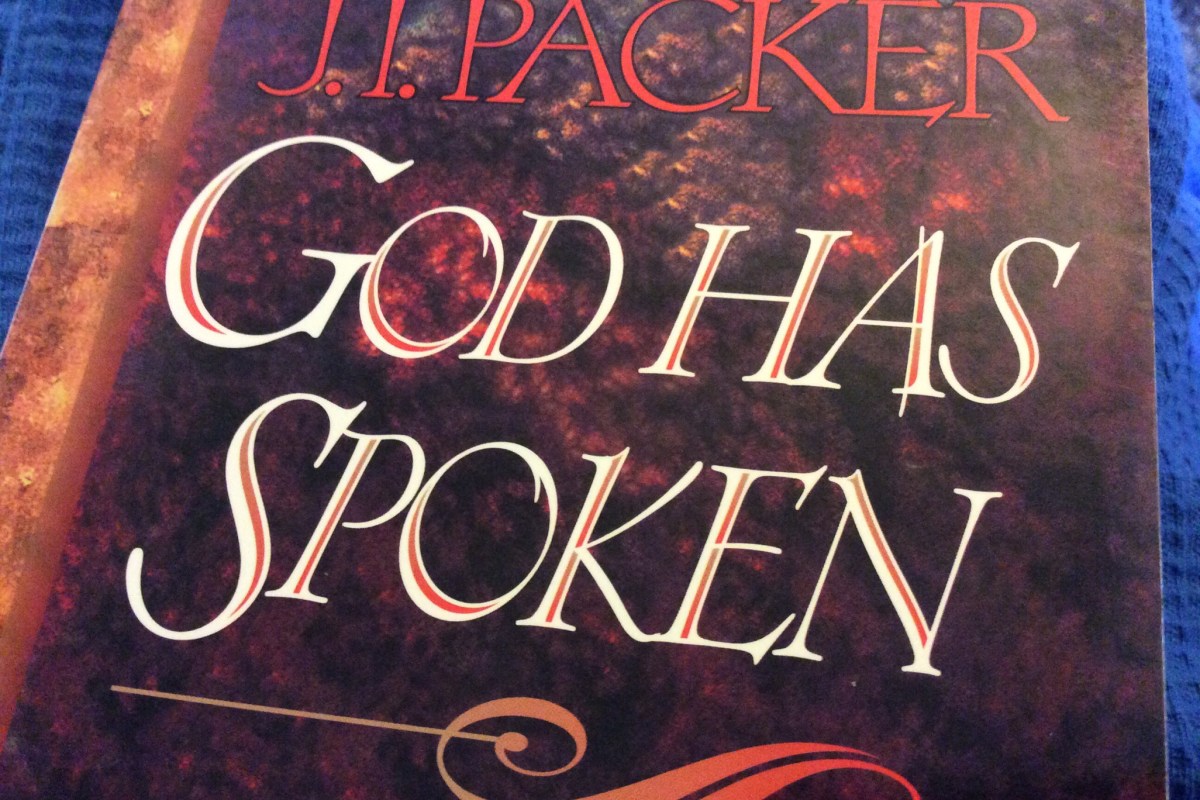
God Has Spoken 1: Reflections on J.I. Packer’s Book

“Theology is for doxology.” J.I. Packer

As I find myself in the middle of a conversation that is dominated by Evangelistic Atheists (EAs) on the one hand and the heirs (wittingly or unwittingly) of American Fundamentalism on the other hand, I find myself disagreeing with both sides with respect to how they frame the debate and on their assumptions about the nature of Christianity. I have described their almost symbiotic relationship in a series of posts entitled  An Unhappy Marriage.

As one who grew up reading and watching Carl Sagan and other modern scientific apologists, I too imbibed a particular views of Christianity especially with respect to the nature of revelation and of the Christian Scriptures aka the Bible. I accepted their understanding of the nature of Scripture and of Biblical Revelation. This view was reinforced by some Christian relatives, televangelists, and pop-culture in general. For instance, my grandfather was into End-Times charts and, as far as I know, I was the only one of his grandchildren that enjoyed these theological conversations. Like Carl Sagan, I was much more into extra-terrestrials but was fascinated by people’s beliefs in and the idea of supernatural beings as well.

For the most part, those who engage in evolution vs. creationism or science vs. Christianity debate seem to share similar views on the nature of Scripture. Obviously, atheists reject that any text ought to be authoritative in the way Christians hold the Bible to be authoritative but many atheists tend to grant that people like Ken Ham and other heirs of American Fundamentalism are normative with respect to how Christians do and ought to read Scripture. Continue reading “God Has Spoken 1: Reflections on J.I. Packer’s Book”

Credulous Skeptics & Mythical Memes 1: Jesus Did not Exist

Credulous Skeptics and Mythical Memes 1: “Jesus Did not Exist”

In this series, I question the veracity of and logic behind some of the popular memes employed by Evangelistic Atheists (EAs) and self-proclaimed skeptics in their supposed war on ignorance. For the most part, I seek minimal claims and suggest an appeal to agnosticism or caution on the part of self-proclaimed skeptics. That is, I simply  ask skeptics to be consistently skeptical by being skeptical with respect to some of the extreme claims that seem to support their generally anti-theistic tendencies. Yet, these extreme claims often undermine their credibility and raise questions about their status as bona fide skeptics. Continue reading “Credulous Skeptics & Mythical Memes 1: Jesus Did not Exist”

Consider the Ant!? Answers in Genesis suggests Invertebrates May Not Be Alive in the “Biblical Sense” or Whaaaat the Sheol?!?!

I can’t make this stuff up. Okay, I could. But I don’t have to because Answers in Genesis has a whole staff of writers who make this stuff up.

In order to defend AiG’s assertion that death only entered the world when ha’adam ate the fruit from the tree of knowledge of good and evil and following a typical AiG strategy, Avery Foley suggests that ants and other insects are not living things[1],

Aside from the possibility that ants, and other insects, are not even alive in the biblical sense . . .

What does “not even alive in the biblical sense” even mean, is it like “knowing someone in the biblical sense”? “Alas, poor Yorick, I knew him well.”[2] Nudge, nudge, wink, wink.[3] Well, under the veneer of real research, AiG often includes footnotes [of course, footnote 1 is the only footnote but surely this indicates that this “scientifically” or “biblically” grounded article must have data to back up such a bold and paradigm shifting claim], let’s scroll down, shall we? Continue reading “Consider the Ant!? Answers in Genesis suggests Invertebrates May Not Be Alive in the “Biblical Sense” or Whaaaat the Sheol?!?!”

Ham-Handed Hermeneutics VI: More Hippo, Less Ham

Or the Harmonization Temptation

This post continues and concludes (for now) my engagement with Augustine’s On the Literal Meaning of Genesis.
I simply want to note some of the intriguing and insightful elements in this work. I will give particular attention to Augustine’s suggestion that Genesis 1 presents God’s causal creation of all things, including human beings, while Genesis 2 describes the formal or material creation of human beings which for Augustine is God’s ongoing creative activity. Finally, I suggest that one of the errors that is common to Ham, Augustine and many errors is the desire to harmonize Genesis 1 and Genesis 2.

[For related Ham-Handed posts follow these links: Augustine IAugustine II, Augustine III)

Continue reading “Ham-Handed Hermeneutics VI: More Hippo, Less Ham”

Humanity was not made for Scripture but Scripture for Humanity

Following from the idea of sola scriptura (scripture alone), many Christians, primarily those coming out of the Protestant traditions, have come to think that if people will just read the Bible they will become followers of Christ. That is, they seem to suggest that acceptance of the Bible as an authoritative text for life precedes acceptance of Christ Jesus as Lord and Savio(u)r.

In convincing the world of this basic though generally erroneous assumption, we Protestants have unfortunately been quite successful. I am reminded of this through my recent interactions with non-Christians of various kinds.

To witness our success, take some time to listen to how non-Christians portray Christianity. For a moment, you might see yourself as in a mirror, it may be a funhouse mirror but it is a mirror, nonetheless.

When you do take time to listen, to ask questions, to create space for your neighbo(u)r to give voice to their ideas, frustrations, fears, dreams, desires, and concerns, I think you will hear what I hear quite consistently. That is, in the distortions of the funhouse mirror, this view of the authority of Scripture is an accurate reflection of what they hear from Christians. Continue reading “Humanity was not made for Scripture but Scripture for Humanity”

WWJT or Christian Twits on Twitter

As I returned to blogging this past August, I also signed on for the Twitter experience. I love it. That is, as a person whose brain produces one liners (even in my dream life), the world of word limits is a limitless world for wordplay & witticism. If only everyone could be a Steven Wright . . . So, in what follows, do not think that I oppose witty repartee or sarcasm. For instance, if anyone follows me on Twitter or reads my blog posts, you will see that I regularly poke fun at Ken Ham and the folks at Answers in Genesis. Continue reading “WWJT or Christian Twits on Twitter”

Ham-Handed Hermeneutics V: Some Inconclusive Thoughts After Reading Augustine’s The Literal Meaning of Genesis

Having just finished reading Augustine’s On the Literal Meaning of Genesis, I offer some inconclusive thoughts on this little work. My comments are inconclusive because Augustine himself is far from conclusive on this subject.

Now, the original impetus for this series of posts was to test the assertion of Ken Ham, founder and spokesperson for the YEC movement Answers in Genesis, that the church has always interpreted the early chapters of Genesis “literally.” In the article that occassioned my response, James R. Mook writes,

In its first 16 centuries the church held to a young earth. Earth was several thousand years old, was created quickly in six 24-hour days, and was later submerged under a worldwide flood. (Page visited 11/23/2015)

Having made this bold claim, Mook immediately acknowledges that three of the most significant and influential church fathers Augustine of Hippo, Clement of Alexandria, and Origen of Alexandria read these passages allegorically. In addition, he notes that from 600-1517, or the Middle Ages, the church largely followed Augustine’s lead. (I will eventually look up Aquinas view, if he gave one.) So, Mook’s bold claim about “the church” holding to young earth and interpreting Genesis 1 as referring to six 24 hour days must be softened a bit, don’t you think? Continue reading “Ham-Handed Hermeneutics V: Some Inconclusive Thoughts After Reading Augustine’s The Literal Meaning of Genesis”

Shh . . . Don’t tell the theists! An Atheistic Evolutionary Argument for the Conspiratorial Perpetuation of Theism

Even in recent history, committed atheists are a relatively small number of the world’s population and some statistics show that as atheism rises in a particular culture so does superstition. Despite their small numbers, some committed atheists are a very vocal minority which in other posts I have referred to as “evangelical atheists” or EAs. That is, some atheists feel it is their duty to spread the good news of atheism.

The assumption is that if theists are awakened from this perceived delusion the world will be a better place, somehow. Public figures like the comedian Bill Maher seem to think that theism is the root of all evil and holds humanity back from our true potential.

Yet, I question the wisdom of awakening humanity from its religious dreams.

For the sake of argument, let us say that the atheists are correct. Let us say, there is no god, there are no gods, etc. Let us say that there is nothing but the material world and that what we call mind is simply an emergent quality that ultimately has a physical explanation.

Of course, if the atheists are correct, then belief in the supernatural, in gods, angels, demons, astrology, ghosts, bodhisattvas, etc. (let’s lump them altogether for the sake of argument) are a byproduct of our biological evolution. Indeed, our imaginations, our ability to imagine the past and future, to think in abstractions, to use metaphor, seems to be something that gives us a distinct advantage as a species.

So, what if theistic beliefs likewise gives us a survival advantage? Are Evangelistic Atheists engaging in a dangerous experiment that could threaten the survival of the human species? Continue reading “Shh . . . Don’t tell the theists! An Atheistic Evolutionary Argument for the Conspiratorial Perpetuation of Theism”

Evangelical, Fundamentalist, and Dispensationalist: What’s the Difference?

A recent conversation with a family member who was a little disturbed by me describing myself as an Evangelical Christian inspired this post. In this conversation, it was clear that the term Evangelical is often seen as and used as a synonym for Fundamentalist.

I am an Evangelical Christian but I am neither a Fundamentalist nor a Dispensationalist (nor a Young Earth Creationist — but I have written enough about that in other posts).

Whaaaaat? Is that even possible?

Yes. Yes it is.

In this post, I attempt to clarify the meaning of the terms evangelical, fundamentalist, and dispensationalist by setting them in their historical and Christian contexts. Continue reading “Evangelical, Fundamentalist, and Dispensationalist: What’s the Difference?”