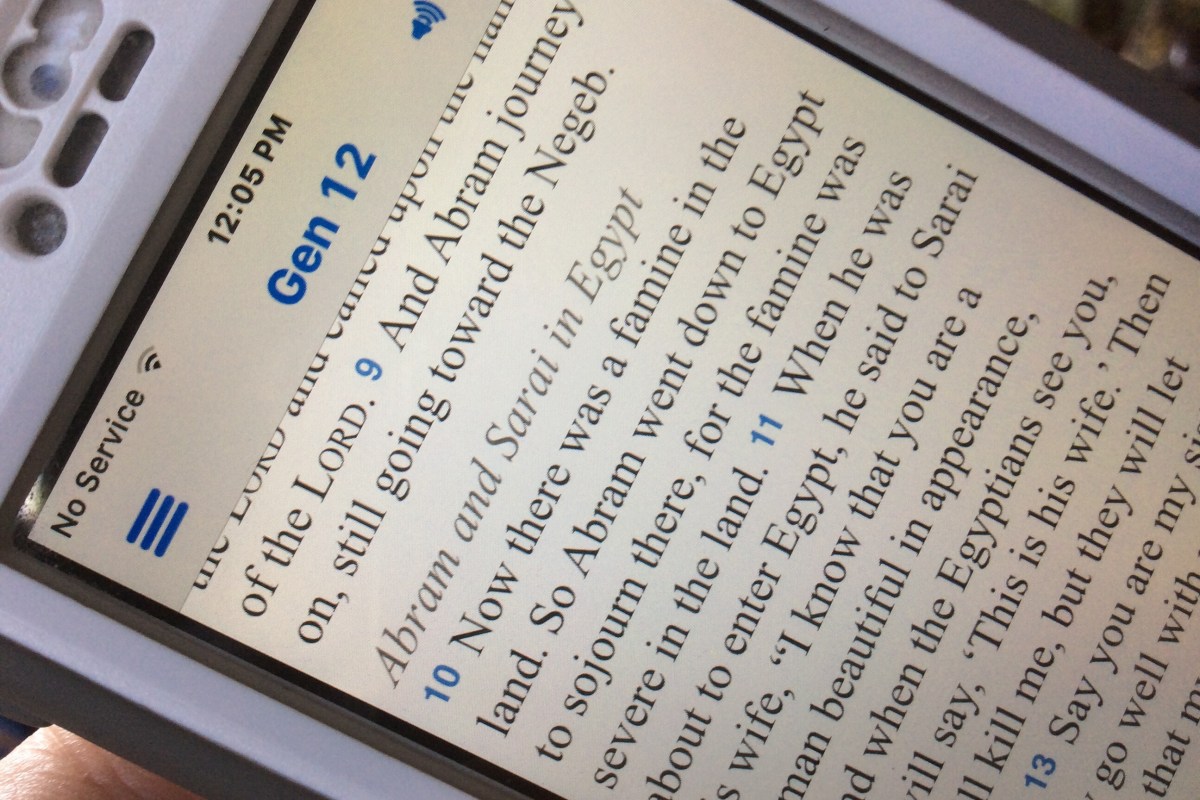
Sarai’s Exodus: from My Princess to Princess (Genesis 12)

In Genesis 12:10-20, immediately after the call of Abram (aka Abraham) and his journey to Canaan (aka the Promised Land), the author tells the following disconcerting narrative:

Abram and Sarai in Egypt

Now there was a famine in the land. So Abram went down to Egypt to reside there as an alien, for the famine was severe in the land. When he was about to enter Egypt, he said to his wife Sarai, “I know well that you are a woman beautiful in appearance; and when the Egyptians see you, they will say, ‘This is his wife’; then they will kill me, but they will let you live. Say you are my sister, so that it may go well with me because of you, and that my life may be spared on your account.” When Abram entered Egypt the Egyptians saw that the woman was very beautiful. When the officials of Pharaoh saw her, they praised her to Pharaoh. And the woman was taken into Pharaoh’s house. And for her sake he dealt well with Abram; and he had sheep, oxen, male donkeys, male and female slaves, female donkeys, and camels.

But the Lord afflicted Pharaoh and his house with great plagues because of Sarai, Abram’s wife. So Pharaoh called Abram, and said, “What is this you have done to me? Why did you not tell me that she was your wife? Why did you say, ‘She is my sister,’ so that I took her for my wife? Now then, here is your wife, take her, and be gone.” And Pharaoh gave his men orders concerning him; and they set him on the way, with his wife and all that he had. (Genesis 12:10-20 NRSV)

So, what is going on here?

Think Exodus. Continue reading “Sarai’s Exodus: from My Princess to Princess (Genesis 12)”

Dear Abe: Bronze Age Advice for Post-Modern Times

Dear Abe,

Recently, my wife and I moved to a new town to look for work. My wife is very beautiful. The other day, I noticed a local business owner checking her out. Is there anyway I can turn this into a job opportunity?

Sincerely,

Married in Memphis Continue reading “Dear Abe: Bronze Age Advice for Post-Modern Times”

Beyond the Veil: Keeping God Safe in His Box

God’s Empowering Presence

When Gordon Fee, retired Professor of New Testament at Regent College, reached the tearing of the Temple curtain that coincided with Jesus death on the cross, he described this as the Spirit of God rending the this thick curtain and shouting, “Get me out of here.” Fee’s book on the Spirit in Paul’s writings is fittingly titled God’s Empowering Presence. The Temple was a symbol of God’s presence in the midst of God’s people. Yet, the New Testament authors and I believe Jesus himself saw the Temple as a barrier to what was truly important to the Creator God, that is God desires to be with his people.

Although many Christian readers miss it, a key theme in both the Old and the New Testaments is the Creator God being present with God’s people. While some might see the climax of the Exodus in the parting of the Red Sea or the receiving of the ten commandments, it seems clear that for Moses and the author of Exodus the construction of the Tabernacle and the descent of the glory of God into their midst is the true climax of this narrative. Continue reading “Beyond the Veil: Keeping God Safe in His Box”

Too Fast to Fossilize and Anarchic Abstinence: Answers in Genesis’s Bodie Hodge Explains the Fossil Record

Those like Bill Nye who bother to engage with Young Earth Creationists will often refer to the fossil record as evidence for both the age of the earth and to discount the contemporary co-existence of human beings and dinosaurs. On the AiG website, to explain the absence of human fossils that one might expect to find as result of a catastrophic flood and the absence of coinciding human and dinosaur remains, Bodie Hodge, Ken Ham’s son-in-law, has offered what he and apparently others at AiG take as a reasonable solution to this problem.

Sit Still, Fossilize and Think About What You’ve Done  Continue reading “Too Fast to Fossilize and Anarchic Abstinence: Answers in Genesis’s Bodie Hodge Explains the Fossil Record”

Ham-Handed Hermeneutics 3: St. Augustine (354-430 AD) and The Literal Meaning of Genesis (Vol I, Book 1.i-xvi)

The Ham-Handed Hermeneutics posts serve two main purposes. On the one hand, I seek to test Ken Ham and AiG’s claims that the Church has always interpreted the early chapters of Genesis in a literal fashion and in such a way that it entails a belief that the cosmos is approximately 7,000 years old. On the other hand, out of personal and scholarly interest, I seek to present thoughtfully and faithfully how the Church Fathers interpreted the early chapters of Genesis and their assumptions about the age of the universe. Continue reading “Ham-Handed Hermeneutics 3: St. Augustine (354-430 AD) and The Literal Meaning of Genesis (Vol I, Book 1.i-xvi)”

Book Review: Inspiration and Incarnation (Chapter 3: The Old Testament and Theological Diversity)

In this chapter on theological diversity in the Old Testament, Peter Enns offers an engaging and helpful introduction to what most biblical scholars Christian and non-Christian have come to recognize as simply being the nature of the Old Testament. Moreover, for many of us with strong commitments to the authority of Scripture, the recognition of theological diversity in the OT has not only enriched our understading of the Scriptures themselves but of the God who inspired them including what it might mean to be creatively inspired by the Creator.  There are three key aspects to Enns chapter on diversity in the OT.

  1. The Old Testament is not a flat text. It is a textured text. Not all books can be read in the same way and some work needs to be done to understand the different genres in the Old Testament.
  2. The books of the OT were written in differing time periods and show signs of being edited to some degree and therefore to some degree there is evidence of the develoopment and revision of thought over time and according to chaning circumstances.
  3. And related to the latter, there are ongoing arguments, discussion, and unresolved tensions within texts and between texts of the Old Testament. (Some of these tension are resolved by and in Christ Jesus.)
  4. Continue reading “Book Review: Inspiration and Incarnation (Chapter 3: The Old Testament and Theological Diversity)”

Ken Ham’s Doctrine of Accelerated Evolution or Supranatural Selection

One of the strangest elements of the teaching of Ken Ham and Answers in Genesis (and that’s saying something when you are talking about people who insist human beings and dinosaurs co-existed) is that with all the fuss they make over the theory of evolution, their position entails the acceptance of an accelerated evolutionary model.

Ham and the folks at AiG insist that the earth (and, indeed, the cosmos) is less than 7,000 years old. The cosmos originated in 4004 BC or 0 anno mundi (See their time-lines.) In keeping with their literalist interpretation of Genesis 1-11 and based on the well-known Noah story, they also insist that there was a global flood in 2348 BC. During this flood, Noah rescued 7,000 “kinds” of animals. Kinds should not be confused with the modern scientifc term species. Nevertheless, from these 7,000 kinds (which included some dinosaurs) all the land animals, aviary animals, and most of the amphibious animals are descended. Continue reading “Ken Ham’s Doctrine of Accelerated Evolution or Supranatural Selection”

Sons of God, Daughters of Adam, and the Nephilim (Genesis 6:1-5)

In my recycled posts about aliens in the Bible, I poke fun at some popular Christian authors who argue that UFOs are real, aliens are really demons in disguise, and therefore suggest that the Bible tells us we will be deceived by these demon-aliens. Often UFO and alien abduction enthusiasts read alien visitation into ancient texts, ancient artifacts, and structures. Who really built the pyramids? Why are gods from the heavens?

Continue reading “Sons of God, Daughters of Adam, and the Nephilim (Genesis 6:1-5)”

How Little Grey Men Got into My Bible or Extra-Terrestrial Eisegesis

New Jerusalem or the Borg?*

When Star Trek: First Contact was in theatres, my friends at Regent College noticed the similarity between the design of the Borg ship and the shape of the Revelation‘s New Jerusalem (Rev. 21:9-27). We came up with our own Christian Borg slogan, “Resistance is futile. You will be resurrected.”

We laughed but maybe we were not so far off. For a quick Google search will reveal that indeed there are aliens in our Bibles! Continue reading “How Little Grey Men Got into My Bible or Extra-Terrestrial Eisegesis”

An Unhappy Marriage III: Don’t Tell Me What I Think (or the Art of Listening)

In this series of posts, I am noting the shared presuppositions of most Young Earthers (YECs) and a particular though common subset of atheists which I am referring to as evangelistic atheists. Evangelistic atheists (EAs) are those who think atheism and atheistic reasoning are “good news” and that as they spread this good news theism (superstition) will decline and the world will become a better place through scientific discovery.

In the west and for obvious reasons, the primary target of evangelistic atheism’s polemical rhetoric is aimed at Christians. In my experience which includes reading, conversation, on-line interaction (i.e. not usually conversational), being a student in anti-Christian contexts, and my own youth which included an element of anti-Christian skeptical agnosticism most evangelistic atheists seem to assume and, indeed, insist that true Christianity is Protestant Fundamentalist Christianity.

Related Posts: Unhappy Marriage II: Stuck in the Middle with YouUnhappy Marriage I: Atheists are from Mars and Young Earthers are from Earth

I am likely stretching my analogy of the Unhappy Marriage to the breaking point but who cares its a blog. Continue reading “An Unhappy Marriage III: Don’t Tell Me What I Think (or the Art of Listening)”